
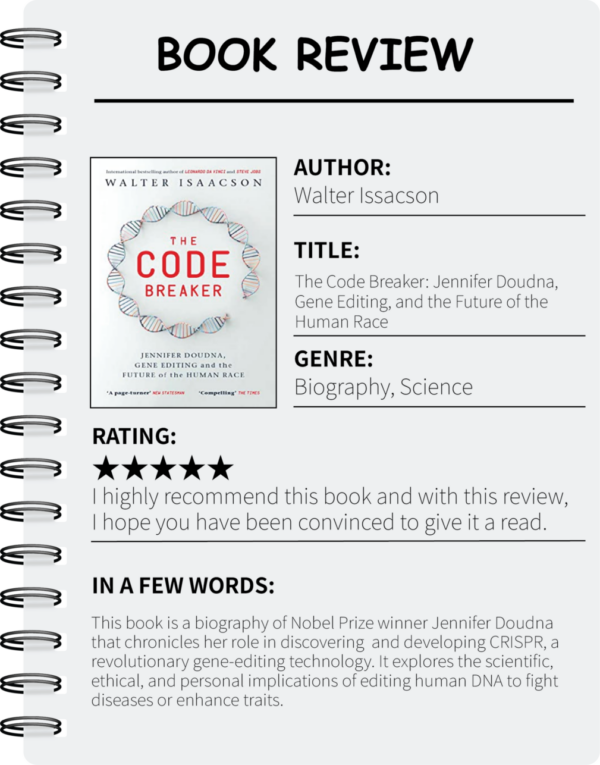
How can I convince you to read this biography?
As a student in the Department of Immunology, I tend to be overly critical when reading books about Immunology and I often choose instead to read about topics unrelated to science altogether. Despite this, I was pleasantly surprised while reading The Code Breaker, a biography about Jennifer Doudna. While the book focused on the discovery of CRISPR-Cas9 technology, the author included multiple interesting subplots to the main story while remaining faithful to the importance and application of science. To help you decide if this will be your next read, skim through this book review first!
Who is Jennifer Doudna? And who is writing about her?
If you’ve stepped into a bookstore in recent years, you may have seen the book covers featuring the unsettling stares of Elon Musk or Steve Jobs peering at you from the shelves. These are biographies written by the well-known American historian and journalist Walter Isaacson. In 2021, Isaacson wrote his first biography about a woman: the scientist Jennifer Doudna.
Jennifer Doudna is a Nobel Laureate in Chemistry, whose research in RNA biology led to the discovery of CRISPR-Cas9. This technology has been an indispensable tool used in genome editing and is a technique which gives mortals the power to change the very essence of an organism’s biology and influence all its future descendants. This has the potential to eradicate genetic diseases yet raises important ethical questions on how far science should be able to influence human biology.
CRISPR-Cas9 and its applications in real life and in industry –if you like to read about facts and science
In this biography, Isaacson thoroughly researches the minor and major events leading up to the origin of CRISPR-Cas9 technology, and further delves into its biological and ethical impacts. Although the biography broaches a topic well-known to those studying the life sciences, Isaacson explains concepts with easy-to-understand analogies that can be understood by most readers. He describes the microscopic struggles for survival happening right under our noses – long before humans even came into the planetary picture. The number 10^31 is inconceivable to us, but that is how many bacteriophages there are on earth. This concept is broken down by the author thus: “there are a trillion bacteriophages for every grain of sand…and in one milliliter of seawater, there can be as many as 900 million”. Bacteriophages are viruses that target bacteria- creating a never-ending evolutionary race as bacteria develop complex defense mechanisms while bacteriophages seek to improve their attacks. If you want to have a refresher on bacterial immunity and learn more about the implications of this technology, Isaacson’s visual storytelling on the drama surrounding the origins and consequences of CRISPR-Cas9 will keep you entertained.
A side quest for yogurt – if you like to read fun tidbits and see a mystery unravel
One of my favorite anecdotes relating to the discovery of CRISPR-Cas9 involves a common breakfast item: yogurt. In the $40 billion global market of the yogurt and cheese industry, bacteriophages are pesky obstacles that target bacteria such as Streptococcus thermophilus, important for the fermentation process. French food scientists Rodolphe Barrangou and Philippe Horvath showed that bacteria can incorporate fragments of viral DNA into CRISPR regions of their genome, allowing them to recognize and defend against future viral infections. They used this discovery to vaccinate their yogurt-making bacteria and published their findings in Science in March 2007. Even though the book highlights the findings of Jennifer Doudna, Isaacson threads multiple such anecdotes about different contributing individuals to the overall fabric of the story. If you’re the type to enjoy reading slow mysteries with subplots that slowly intertwine into a larger picture, you’ll enjoy Isaacson’s style of writing.
The struggle is real – if you like to see your struggles reflected and feel reassured about your own decisions
Jennifer Doudna’s work has revolutionized modern science and her academic career as both a student and as a professor has been outstanding. Isaacson depicts Dr. Doudna as a passionate and charismatic scientist who not only strives to push herself towards her own goals but also deeply cares about her colleagues and students. While Isaacson did a wonderful job showing the strengths of the scientists featured in his writing, he also shows a realistic depiction of their hardships and worries. For instance, he highlights the uncertainties that Doudna faced even at the height of her career. He writes about her temporary stint in an industry job and the resulting anxiety she suffered in a different setting. He describes the doubts Doudna felt after making a major decision that impacted not only herself but also the members of her lab, and how she navigated through these changes and sought help from those around her. It was reassuring to read these very real and relatable stories and see that even well-known scientists face indecisiveness, doubts, and failures. If you’re the type to enjoy finding similarities between yourself and the main character of a story, then reading the Code Breaker will feel at once familiar and reassuring.
I highly recommend this book review and with this, I hope you have been convinced to give it a read.

Vera Lynn

