
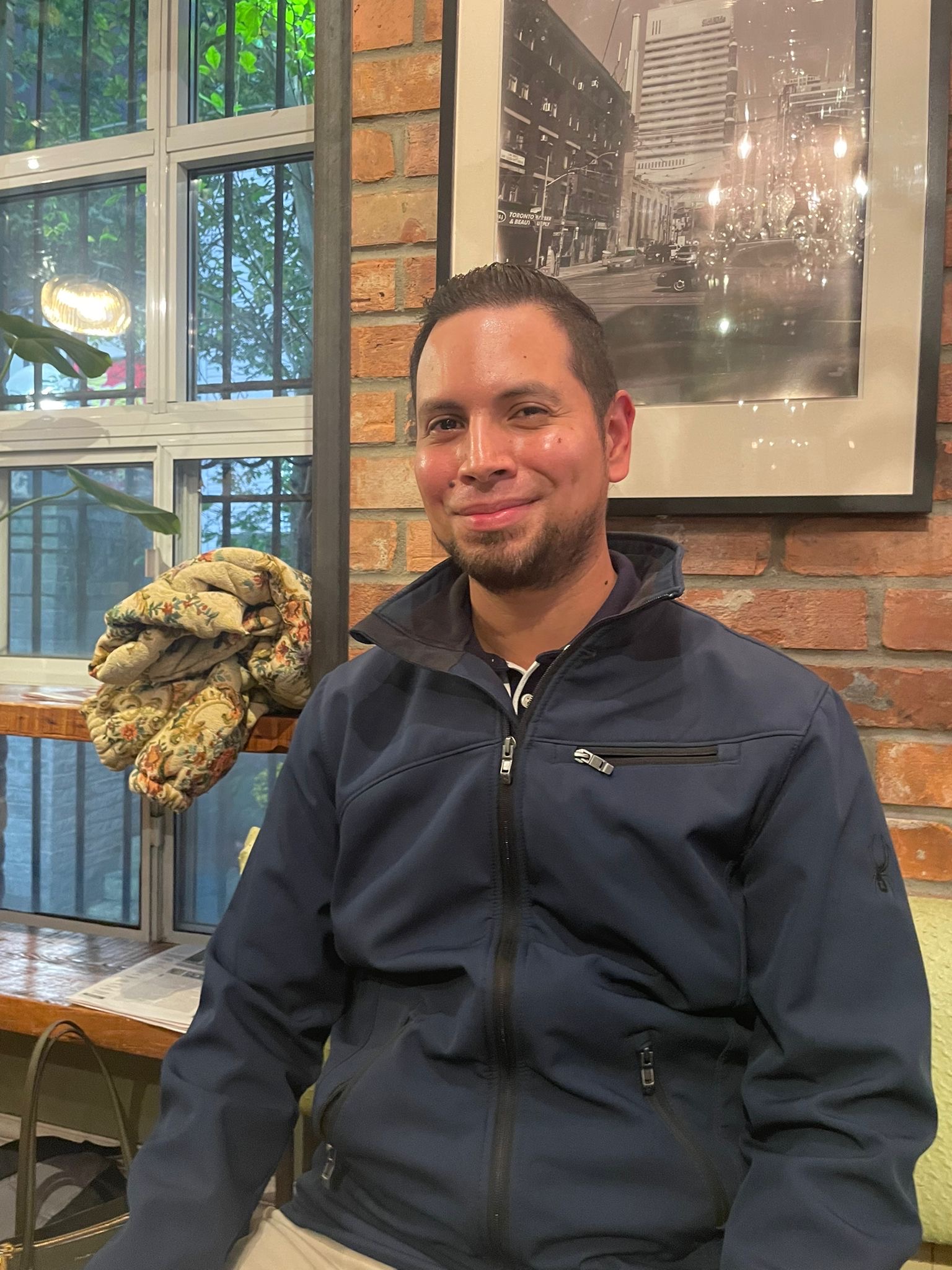
Today we’re joined by Juan Mauricio Umaña, a Master’s Immunology Program and Mallevaey lab alumnus. Juan has worked at BlueRock Therapeutics for over six years, first beginning as an Associate and later growing into his current role as Principal Research Associate. His work is split between the wet lab- where he leads experimental design- and a managerial role, where he drives projects from conception to execution.
Can you tell me about your role and what your day-to-day routine looks like?
“It’s a very collaborative environment,” Juan explains. “As a Principal RA, I help design experiments alongside my team, define what questions we want to answer, and drive the projects forward. It’s not just about doing one experiment at a time- it can be about managing an entire research process!” His schedule balances both hands-on lab work and planning. Roughly half of his week is spent conducting experiments, analyzing data, and writing experimental workflows; the other half involves meetings and discussions to guide research direction. “It’s about asking the right questions, planning the next steps, and making sure what we do fits within the bigger project timelines,” he adds.
Sounds like what you’re doing now is like what you did during your graduate degree… what kind of differences are there being in a more business-adjacent setting?
While the scientific curiosity and structure of his work feel similar to graduate school, Juan notes several key differences in the industry setting. “In grad school, you’re often the entire team,” he says, “you do everything by yourself. In industry, everything is collaborative. You lean on other people’s expertise, and you don’t have to reinvent the wheel every time.” He also highlights the importance of structure and planning. “In grad school, you can sometimes take more time to explore different approaches. But in industry, your work is often part of a bigger puzzle. Others depend on your results. Timelines matter. If you’re developing an assay, for example, you need to plan when it’ll be ready so that you can hand it off to the next team.”
Being in grad school can be great for picking up soft and technical skills – which ones do you find have been helpful in your career now?
Juan credits his Master’s degree for shaping both his technical and soft skills. On the technical side, he mentions experimental design, flow cytometry, and meticulous documentation. These are skills that translate directly into his current role. “In grad school, I was a bit loose about documenting experiments,” he laughs. “But in industry, that’s crucial. Everything must be recorded in detail so that anyone can replicate your work.” He also emphasizes communication and adaptability. “Grad school teaches you how to present complex data to different audiences. In industry, that becomes even more important. When I present to my manager, I might go into detail. But if I’m talking to executives, I need to focus on the key outcomes that help them make decisions.” Another major takeaway from graduate school was mentorship. “I was a TA and had undergraduates in the lab, and that really helped me learn how to teach and lead,” Juan reflects. “Now, mentoring junior associates or co-op students is a big part of what I do. It’s rewarding to help others grow while also learning from them.”
An important question for those of us graduating soon… how did you find your position?
Juan’s path to BlueRock Therapeutics came naturally from his academic background in immunology. After finishing his MSc, he completed a six-month research position in transplant immunology at UHN before discovering the opportunity at BlueRock. “I think the stars aligned,” he recalls. “They were looking for someone with an immunology background, and I was fortunate to have the right combination of skills and experience. But I also believe in the idea that you create your own luck… you know what they say, opportunity is when luck meets preparation.”
Thank you for your time today! Any last advice for current graduate students?
Juan’s advice centers on humility, patience, and a willingness to keep learning.
“Be receptive and patient,” he says. “Science is about realizing how much you don’t know. The more you learn, the more you understand how little you really know—and that’s okay.” He also stresses the importance of transparency and initiative, especially when working with supervisors or managers. “If you make a mistake, be upfront about it. That’s how trust is built. And when you bring a problem to your manager, come up with potential solutions too. It shows initiative and maturity as a scientist.” Finally, he encourages graduates to stay open to growth. “Even now, I’m learning new technologies all the time. The field evolves fast, and you need to evolve with it. Stay curious and adaptable—that’s what will carry you forward.”
Juan Mauricio Umaña’s journey from MSc student to Principal Research Associate reflects how a foundation in curiosity and collaboration can lead to a thriving career in the industry. For students that wish to hear more about his experiences during his graduate studies or during his current position at BlueRock Therapeutics, Juan has consented to being contacted through his LinkedIn profile.

Vera Lynn
